Introduction
Nusantara textiles (wastra Nusantara) hold a wide range of aesthetic and cultural value. Beyond the popularity of batik and ikat, there is a distinct traditional Javanese cloth that occupies its own place in the history of Indonesian dress: Kain lurik.
The word lurik comes from the Javanese term lorek, meaning stripes or banded patterns. Fundamentally, lurik is a woven fabric characterized by striped or checked thread arrangements laid out symmetrically or asymmetrically. Over time, lurik production has split into two main methods: mechanical production using Alat Tenun Mesin (ATM) and traditional handloom production using Alat Tenun Bukan Mesin (ATBM).
This article takes an in-depth look at Lurik ATBM—from its historical origins, the philosophical meanings of its motifs, the highly skilled production process, to its potential and economic value as a high-value creative industry commodity.
1. Historical Trajectory and Origins of Lurik
Historically, lurik has been known among the Javanese people for centuries. The existence of this striped cloth is recorded in several ancient literary sources and medieval inscriptions:
- Ancient Kingdom Era: The earliest traces of lurik appear on the reliefs of Borobudur and Prambanan temples, which depict figures wearing striped garments. The Er Hangga inscription from the Majapahit kingdom era (11th to 14th centuries) also mentions striped clothing as part of contemporary dress codes.
- Mataram Sultanate Period: In the 18th century, when the Mataram Islamic polity flourished in the Surakarta (Solo) and Yogyakarta regions, lurik played an important role in social structure. Lurik was not only everyday wear for commoners (such as farmers and traders) but was also incorporated into palace ceremonial attire for soldiers, court servants (abdi dalem), and noble families with specific motifs assigned.
- Evolution of Weaving Centers: Areas such as Klaten (notably Pedan), Yogyakarta (Bantul and Sleman), and Surakarta became legendary centers of lurik weaving production from the early 20th century onward.
2. Philosophy and Symbolic Meaning of Lurik Motifs
For traditional Javanese communities, a piece of lurik is more than a body covering; it is a medium of prayer, social status, and life philosophy (piwulang). Each pattern and line composition carries its own meaning:
- Motif Telupat (Telu-Papat):
Meaning: Composed of arrangements of three (telu) and four (papat) lines. This motif symbolizes balance in life and serves as a reminder to be eling (mindful/rememberful) of the Creator and to act honestly and justly.
- Motif Udan Liris (Drizzle/Rain):
Meaning: Dots and fine lines that resemble a light drizzle symbolize fertility, blessing, and continuously flowing sustenance. Historically, leaders wore this motif in the hope of bringing prosperity to their people.
- Motif Tuluh Watu:
Meaning: Literally "strong stone." This motif is traditionally believed to function as spiritual protection (tolak bala), shielding the wearer from illness and misfortune.
- Motif Sapit Urang:
Meaning: These motifs feature bold characters and thick lines that symbolize courage, firmness of heart, and fighting spirit; they are often worn in martial contexts or certain traditional ceremonies.
3. Differences Between Lurik ATBM and Machine Lurik (ATM)
To understand the economic value of Lurik ATBM, it is important to distinguish it from machine-made lurik produced in factories:
| Characteristic | Lurik ATBM (Alat Tenun Bukan Mesin - non-machine loom) | Machine Lurik (Alat Tenun Mesin - ATM) |
|---|---|---|
| Production Process | Uses human power (hands and feet) | Uses automated electrically driven machines |
| Fabric Texture | Soft, slightly thick, porous, cool to the touch, with a distinctive handfeel | Thinner, smooth, uniform, and stiff |
| Dyeing | Often uses natural colorants (natural dye) or selected synthetic dyes | Mass chemical dyes |
| Production Capacity | Limited (around 2–5 meters per day per weaver) | Very high (hundreds of meters per day) |
| Exclusivity | Each piece has subtle uniqueness (not 100% identical) | Mass-produced and precisely identical |
| Artistic Value & Market Value | High (craftsmanship / heritage luxury) | Economical / Mass market (fast fashion) |
4. Detailed Stages of Lurik ATBM Production
Producing a single sheet of lurik on an ATBM requires extreme precision, technical routine, and exceptional patience. The stages include:
- Yarn Winding & Dyeing (Immersion): Cotton or silk yarn is wound and dipped into dye baths. Natural dyeing commonly uses indigo (Indigofera tinctoria) for blue, secang wood for red, and mahogany bark for brown.
- Warping (Setting the Warp Threads): The process of arranging parallel warp threads to the desired fabric length on the warping frame. This determines the basic stripe pattern and color layout of the lurik.
- Nyucuk (Threading the Reed and Heddles): Warp threads are drawn one by one through the heddle eyes and the reed using special needles. This stage requires full concentration because a single misplaced thread can ruin the entire motif.
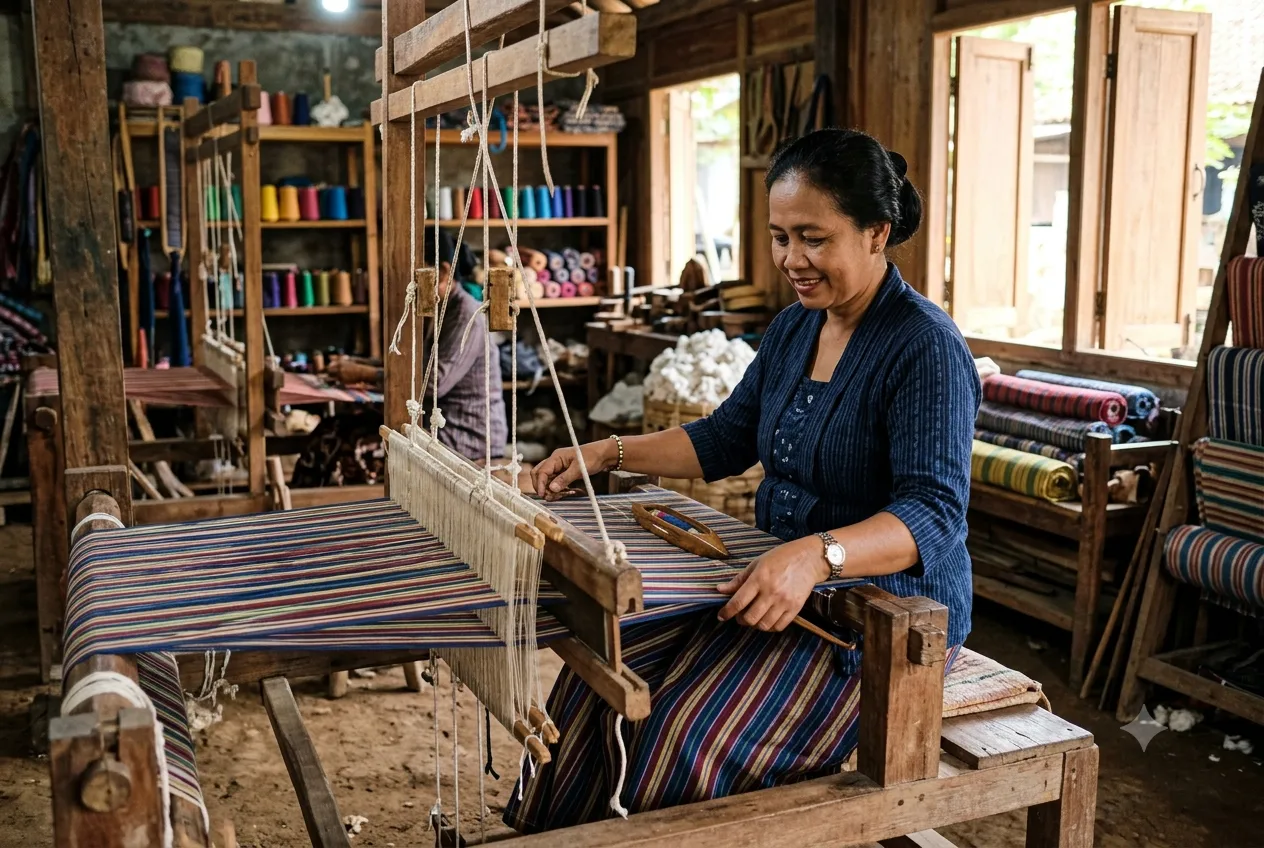
- Weaving: The weaver sits at the ATBM, moves the beater (keplok) with the hands to pass the shuttle carrying the weft, and alternately presses wooden pedals with the feet to open the warp. The rhythm of the pedal strikes and the beater creates the characteristic cadence of home-based weaving.
5. Economic Value Analysis and Market Potential
As global awareness of sustainable fashion and appreciation for artisanal craft grow, Lurik ATBM has been transforming from a lower-to-middle class textile into a high-value lifestyle product.
A. Market Segmentation and Selling Prices
- Local Market & Souvenirs: Processed lurik items such as wallets, bags, and casual shirts target the domestic market at mid-range price points.
- High-End & Designer Market: Lurik ATBM made from fine yarns (such as premium cotton or silk) with natural dyes are marketed to interior designers, fashion houses, and ethnic fashion lovers. Raw ATBM fabric prices range from Rp 150.000 to Rp 800.000+ per meter, depending on motif complexity and dye type.
B. Local Economic Empowerment and MSME Hubs
The home-based lurik ATBM industry functions as an economic pillar in many rural areas:
- Employment Absorption: Provides local employment, especially for women and older residents in Klaten (such as Pedan and Cawas), Bantul, and Sleman.
- Multiplier Effect: Stimulates growth in supporting sectors like local yarn farmers, natural dye suppliers, garment MSMEs, and craft-based tourism (eco-tourism / craft tour).
C. Exports and the Global Market
Handwoven fabrics (handwoven fabric) have a distinct appeal in international markets such as Japan, Europe, and the United States. Overseas consumers highly appreciate the craftsmanship, the storytelling behind each product, and the eco-friendly nature of these textiles.
6. Challenges and Strategies for Future Development
Despite its large economic potential, the Lurik ATBM industry faces several critical challenges:
- Shortage of Weaver Regeneration: Most ATBM weavers are currently over 50 years old. The lack of interest among younger generations in traditional weaving careers is a serious threat to the continuity of this art.
- Production Efficiency & Raw Material Costs: Fluctuating prices of imported yarn and long production times make Lurik ATBM hard to compete on price with printed lurik fabrics.
- Competition from Imitation Fabrics: The proliferation of factory-printed fabrics that mimic lurik patterns at much lower prices often confuses uninformed consumers.
Preservation & Innovation Strategies:
- Designer Collaboration: Encourage partnerships between traditional artisans and contemporary designers to create ready-to-wear collections that appeal to young consumers.
- Education & Brand Storytelling: Educate the public about quality differences between ATBM and printed fabrics via digital platforms and social media.
- Digital Marketing: Leverage e-commerce and visual content strategies to reach buyers directly (D2C - Direct to Consumer) at national and international levels.
- Government Support & Equipment Modernization: Provide assistance for more ergonomic ATBM tools and geographic indication certification to protect the authenticity of lurik from specific regions.
Conclusion
Lurik ATBM is not just a length of striped cloth; it is a harmonious combination of historical heritage, deep Javanese philosophical values, and meticulous artisanal skill. Amid modernization and fast fashion, Lurik ATBM demonstrates that traditional textiles can endure and even ascend into heritage luxury products with high economic value.
With design innovation, transparent and eco-friendly production processes, and the right digital marketing support, Lurik ATBM has great potential to continue developing as both a source of Indonesian cultural pride and a driver of local economic activity.