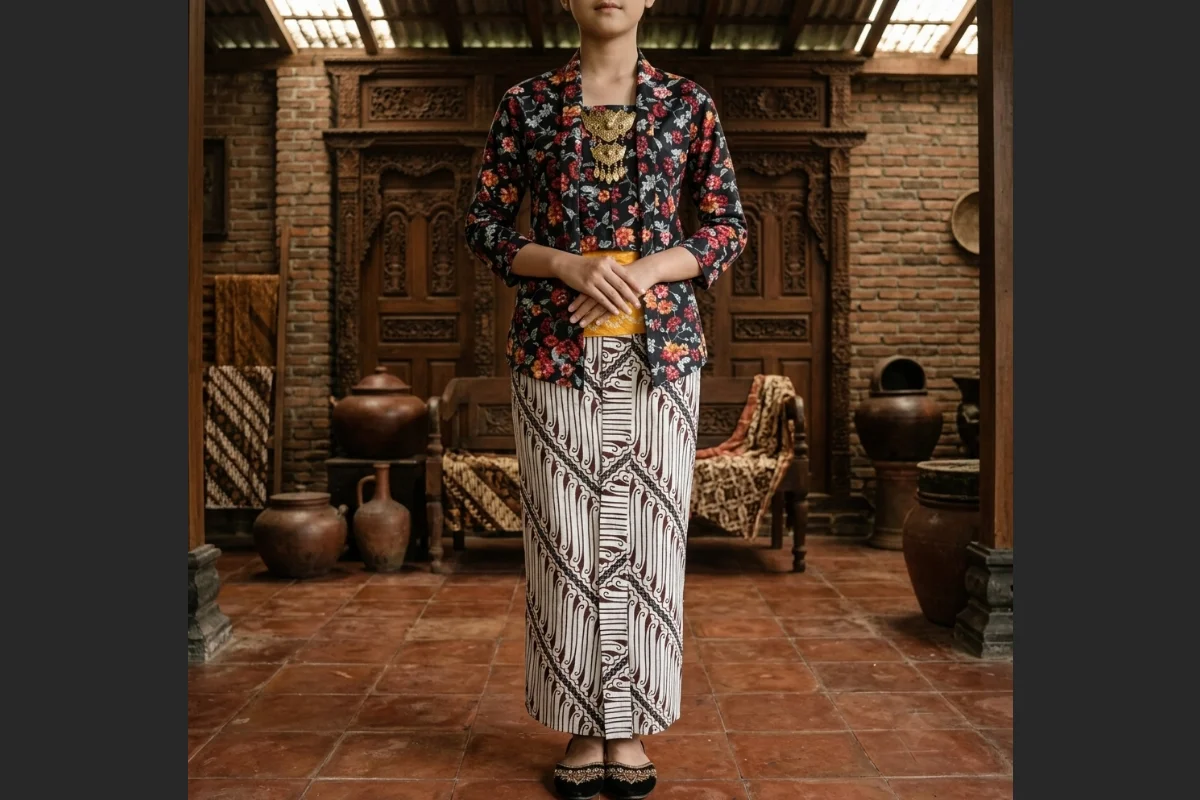
Some garments are worn simply because their design is beautiful. Others feel more special because they hold a story in every detail.
Surjan Kembang and Kebaya Kembang are Javanese garments that reveal the connection between clothing, identity, manners, and the beauty of nature. Floral motifs convey a fresh and graceful impression, while the garments’ shapes retain the neat, dignified character of Javanese tradition.
The term Surjan Kembang is often used for surjan with floral patterns, including those known as Surjan Ontrokusuma. Meanwhile, Kebaya Kembang refers to kebaya with flower motifs or floral decorative patterns. Their cut, materials, motifs, and ways of wearing can vary by region, cultural environment, era, and the event’s needs.
This article discusses the meaning, distinguishing features, philosophy, development, ways of wearing, and styling inspiration for Surjan Kembang and Kebaya Kembang in both traditional and modern contexts.
Getting to Know Surjan Kembang
What Is a Surjan?
A surjan is a traditional Javanese men’s garment that typically has long sleeves, a standing collar, and a front button opening. It is closely associated with the Sultanate of Yogyakarta, although its influence and use are known more broadly across Javanese culture.
Surjan is often called baju takwa or sirojan. In the cultural database of the Special Region of Yogyakarta, those terms are linked to meanings of radiant light or enlightenment.
Over time, surjan has appeared in various materials and motifs. One of the best-known types is surjan lurik (lurik is a traditional striped weave). There are also surjan with floral motifs that give a more decorative and special impression.
Distinctive Features of Surjan Kembang
- Has the surjan cut with a standing collar and long sleeves.
- Uses fabric with flower, floral, or flower-like decorative patterns.
- Appears more festive compared to plain or simply striped surjan lurik.
- Can be made from cotton, woven textiles, printed fabrics, or other materials as needed.
- Commonly paired with jarik batik (jarik: wrapped skirt), blangkon (traditional Javanese headdress), and traditional footwear.
A floral motif does not always mean a single specific pattern. There are fabrics with tiny repeated flowers, bouquets, garden-style blooms, or combinations of flowers and leaves. Therefore, the look of Surjan Kembang can feel classic, formal, delicate, or more modern depending on color and motif scale.
Philosophy in Surjan Details
One thing that makes the surjan interesting is the philosophy associated with its button arrangement. In the Special Region of Yogyakarta’s cultural records on formal warrior attire (kesatriya ageng), the surjan is described as having six buttons at the neck, two buttons at the chest, five buttons on the sleeves, and three hidden buttons on the body.
| Surjan Detail | Known Symbolic Meaning |
|---|---|
| Six buttons at the neck | The Six Pillars of Faith (Six Articles of Belief) |
| Two buttons at the chest | The two phrases of the shahada (Islamic declaration of faith) |
| Five buttons on the sleeves | The Five Pillars of Islam |
| Three hidden buttons | Self-control related to bodily desires, eating-drinking, and satanic tendencies |
This interpretation shows that the surjan is not only designed to create a neat appearance. Its garment details can also serve as reminders of belief, ethics, and self-discipline. Button arrangements may vary by model, region, maker, and intended use.
Getting to Know Kebaya Kembang
Kebaya Kembang is a term used for kebaya with flower motifs or floral decorative patterns. The basic models can be kebaya kutubaru, long kebaya, kebaya encim, or other kebaya styles that use floral-patterned fabric.
Unlike names that denote a specific cut—such as kebaya kutubaru or kebaya encim—the word “kembang” (flower) refers more to the character of the motif. Thus, Kebaya Kembang can come in various silhouettes. Materials may include cotton, voile, mori, brocade, silk, or other fabrics depending on the design and the event.
Distinctive Features of Kebaya Kembang
- Uses motifs of flowers, leaves, bouquets, or other floral decorative patterns.
- Offers color choices from soft pastels to bright hues.
- Can be worn as daily kebaya, family-event attire, formal wear, or bridal clothing depending on the model.
- Paired with jarik batik, kain lurik (lurik: striped weave), sarong, skirt, or modern bottoms.
- Can be worn with a sanggul (traditional hair bun) and traditional accessories or with modern hairstyles.
Kebaya did not develop along a single cultural line. Museum Sonobudoyo explains that the history of the kebaya is linked to trade routes, social encounters, and cultural acculturation across the archipelago. Variations of the kebaya then developed with regional characters, including Javanese kebaya and kebaya encim.
Meaning of Floral Motifs on Kebaya
Floral motifs usually convey beauty, freshness, softness, and elegance. Flowers can also remind people of the relationship between humans and nature and express hopes for a good life.
Motif meaning does not stand alone. Color, flower size, pattern arrangement, fabric, kebaya cut, and the event all influence the impression created. A kebaya with small flowers and soft colors can feel understated, while large motifs and contrasting colors can give a bolder, more festive impression.
Surjan Kembang and Kebaya Kembang: What Connects Them?
Surjan Kembang and Kebaya Kembang can be paired as couple or family outfits. Both use floral elements, creating a harmonious look without needing identical motifs.
- Choose colors that belong to the same palette.
- Use floral motifs with balanced scales.
- Select fabrics with a similar level of formality.
- Pair with complementary batik or lurik bottoms.
- Use accessories sparingly so the outfits don’t appear excessive.
| Aspect | Surjan Kembang | Kebaya Kembang |
|---|---|---|
| Wearer | Men | Women |
| Main characteristic | Surjan cut with floral or plant motifs | Kebaya cut with floral or plant motifs |
| Bottoms | Jarik batik (usually with wiron for formal looks) | Jarik batik, kain lurik, sarong, or other bottoms depending on the event |
| Complements | Blangkon, keris depending on context, and selop | Sanggul or modern hairstyles, brooches, shawls, and accessories |
| Impression | Neat, dignified, classic, and graceful | Graceful, soft, fresh, and feminine |
How to Wear Surjan Kembang Traditionally
- Wear a comfortable undershirt that does not disturb the surjan’s shape.
- Put on the jarik batik neatly. For formal events, the jarik can be tied with wiron as needed.
- Wear the Surjan Kembang and ensure the shoulders and sleeves are in a comfortable position.
- Button the surjan according to its design. Not all models have the same button arrangement.
- Complete the outfit with a blangkon if the event and chosen style call for it.
- Wear selop or footwear appropriate to the event’s formality level.
- A keris may be used in customary or ceremonial contexts following local protocol.
How to Wear Kebaya Kembang Traditionally
- Wear a comfortable inner layer suitable for the kebaya fabric.
- Put on the prepared jarik batik, kain lurik, or other bottom.
- If using a stagen (waist binder), wrap it comfortably and not too tightly.
- Put on the kebaya, then tidy the front using buttons, pins, or a brooch according to the model.
- Adjust the kebaya length to balance with the bottom.
- Style the hair with a sanggul or a modern look that complements the overall outfit.
- Add accessories sparingly, such as a brooch, shawl, or earrings.
Stagen is part of traditional dressing and is not comfortable for everyone. For modern use, you can choose other inner garments that are more comfortable while still keeping the outfit neat.
Contemporary Usage Inspiration
Weddings and Family Events
Surjan Kembang can be worn by the groom, family members, or guests. Kebaya Kembang can be chosen for mothers, bridesmaids, or other family members with colors adjusted to the event theme.
Siraman and Midodareni
For events with a strong traditional atmosphere, pair garments with jarik batik, sanggul, blangkon, and more classic accessories. Choose comfortable materials because these ceremonies can last a long time. (Siraman: pre-wedding bathing ritual; Midodareni: the traditional evening ceremony before the wedding.)
Graduation and Cultural Festivals
Kebaya Kembang is a good option for graduation (wisuda) because it presents a neat, elegant look while retaining cultural identity. Surjan and kebaya with floral motifs can also be used for school activities, office events, exhibitions, performances, or national commemorations.
Modern Casual Style
Kebaya Kembang can be paired with a plain skirt, tailored trousers, or jeans for a more relaxed look. Surjan Kembang can also be worn without the full set of traditional accessories—for example with plain fabric trousers and simple footwear—provided it suits the context.
Tips for Choosing Surjan Kembang and Kebaya Kembang
- Match the event: Choose fabric, color, and accessories according to the event’s formality.
- Prioritize comfort: Check shoulder width, sleeve length, chest circumference, kebaya length, and freedom of movement.
- Choose a suitable motif: Small motifs are generally easier to mix and match, while large motifs can become a focal point.
- Combine colors carefully: You don’t need an exact motif match; using one main connecting color is enough.
- Inspect fabric and stitching quality: Pay attention to neat stitching, button strength, shoulder seams, and motif clarity.
- Support local products: Choosing garments from local artisans helps preserve skills and the creative economy.
How to Care for Floral-Patterned Garments
Care depends on the fabric type. Before washing, check the label or ask the seller.
- Separate from garments that bleed color easily.
- Use a mild detergent and an appropriate amount of water.
- Avoid vigorous scrubbing or wringing.
- Dry in the shade so the motif colors don’t fade quickly.
- Iron from the inside with a temperature suitable for the fabric.
- Store completely dry.
- For certain materials, use a specialist laundry service or dry cleaning.
Javanese Clothing Collection from Ola Store Solo
If you are looking for Javanese garments from Solo artisans, Ola Store offers various lurik and traditional clothing, including Surjan Lurik, Kebaya Kutubaru Lurik, kain lurik ATBM (ATBM: handloom), and jarik batik.
Ola Store is located at Pasar Klewer Solo Lt. 4 Blok C24 and accepts online orders. The available collection may change according to stock, motifs, materials, and sizes.
See Ola Store's lurik and Javanese clothing catalog
If you want to ask about sizes, motifs, materials, or outfit choices for a specific event, contact Ola Store via WhatsApp.
FAQ about Surjan Kembang and Kebaya Kembang
Is Surjan Kembang the same as surjan lurik?
Not always. Surjan lurik uses the striped lurik weave, whereas Surjan Kembang refers to surjan with floral or plant decorative motifs. Both share the basic surjan cut, but their materials and visual impressions can differ.
Is Kebaya Kembang an official kebaya model name?
The term Kebaya Kembang is better understood as a label for kebaya with flower motifs. Its silhouette can be kutubaru, long kebaya, encim, or other variations.
Must couples wear the exact same motif?
No. Harmony can be achieved through shared colors, similar formality levels, or one common motif element. Exactly identical motifs are not always necessary.
Are these garments only suitable for formal events?
No. With simpler combinations, surjan and kebaya with floral motifs can be worn for cultural activities, family photos, graduation, community events, and casual styles.
Conclusion
Surjan Kembang and Kebaya Kembang demonstrate that Javanese traditional attire can combine tidy silhouettes, beautiful motifs, and deep cultural meanings.
Surjan Kembang carries the dignified character of Javanese men’s wear. The surjan’s button details are often interpreted as reminders of faith, the shahada, the pillars of Islam, and self-control. Meanwhile, Kebaya Kembang presents the kebaya’s softness and elegance through floral motifs that relate to nature and daily life.
Neither garment needs to be worn rigidly. Traditional clothing remains alive when it is cared for, understood, and used sensibly in a modern context. By choosing comfortable materials, appropriate motifs, and harmonious pairings, Surjan Kembang and Kebaya Kembang can be chosen for customary ceremonies, weddings, graduations, cultural activities, or modern styles.
More than just garments, Javanese clothing is part of a story. Every fabric, motif, stitch, and way of wearing can remind us that cultural heritage stays alive when it continues to be worn and appreciated.
Note: Terms, philosophies, wearing details, and histories of traditional garments can vary by region, royal court, family, community, and cultural sources. This article offers general explanations and is not intended to replace the specific rules for particular customary ceremonies.